Fishin' Frenzy: Mechanics, Risk, and What Actually Happens When You Spin
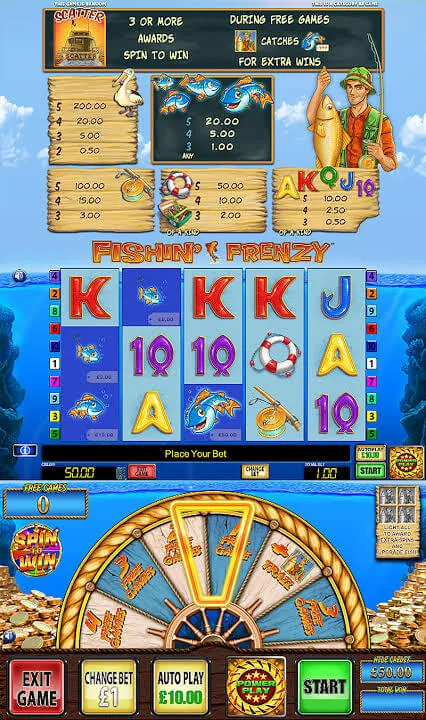
Is Fishin' Frenzy real money or just demo? Both—but if you're playing for cash in the UK, the site needs a UKGC remote licence, and you'll face a £5 stake cap per spin (£2 if you're 18–24). The game itself is a Blueprint Gaming slot, five reels, ten fixed paylines, medium volatility, 96.12% RTP. The hook is the free-spins bonus: land three or more scatter symbols, win ten spins, and every fish symbol on the reels turns into a cash prize collected by a fisherman wild. Miss the bonus, and base-game wins are small and scattered.
This breakdown covers how a round works, where your stake goes, what the bonus actually pays, how volatility shapes your session, and the practical steps to play—demo or real money—on a phone or desktop. No hype, no guarantees: just the maths, the rules, and the points where you lose control if you don't set limits first.
How a Round Works: Stake, Spin, and the Two Ways You Win
Every spin costs between 10p and £5.00 (or £2.00 if you're under 25). That stake covers all ten paylines at once—you can't adjust the number of lines. Press spin, the reels stop, and the game checks for matching symbols left-to-right on any of the ten fixed patterns. Three or more of the same symbol on a payline pays out according to the paytable; the fisherman wild substitutes for everything except the scatter.
The scatter—a fishing-rod logo—triggers the bonus if three or more land anywhere on the reels. You don't need them on a payline. Three scatters give ten free spins; four give fifteen; five give twenty. During those spins, any fish symbol that appears is collected by the fisherman wild and converted into a random cash prize worth 2× to 10× your total stake. Base-game fish symbols pay nothing—they only convert during the bonus.
Volatility is medium, which means you'll see regular small wins in the base game—often 0.5× to 2× your stake—but the bulk of your return depends on hitting the bonus. Go fifty spins without triggering free spins, and your balance will drift down. The RTP of 96.12% assumes infinite play; in a single session, variance dominates.
Where You Lose: Volatility, Dry Runs, and the Cost of Chasing Bonuses
The game is built so that base-game wins cover only part of your spend. The free-spins feature holds the majority of the RTP, and the scatter trigger rate is roughly 1 in 100 to 1 in 150 spins, depending on variance. If you start with £20 at 50p a spin, you've got forty spins. Hit the bonus early, and you might walk away ahead. Miss it, and you'll likely lose most of that £20 before you see ten free spins.
Inside the bonus, the fisherman collects every fish symbol and assigns a random prize. The prize range is 2× to 10× your stake per fish, but distribution isn't uniform—lower values are more common. If you get ten free spins and only four fish land across those spins, your total bonus win might be 15× to 30× stake: solid, but not always enough to recover a long losing streak beforehand.
- Fifty base-game spins at 50p = £25 staked, typical return £18–£22 without a bonus
- One bonus trigger with eight fish collected, average 5× per fish = 40× stake win, or £20 at 50p stake
- Net result: £2–£7 loss after the bonus, if it arrives on spin 50
The risk sits in the wait. The longer you play without a bonus, the deeper the hole. Autoplay makes it worse—spins run faster than you can track spend. Medium volatility means you won't blow your balance in ten spins, but you will grind it down steadily if the scatter doesn't show.
Stake Limits, Affordability Checks, and What Happens at £150 a Month
UK rules cap stakes at £5.00 per spin for players aged 25 and over, £2.00 for 18–24-year-olds. The operator enforces this in the game settings—you can't override it. If you're playing at £5.00 a spin, one hundred spins costs £500, and you can burn through that in under twenty minutes on autoplay.
Affordability checks start at £150 net deposits in a rolling month. The operator asks for proof of income and expenditure before you can deposit more. First-stage checks use credit-reference data; second-stage checks need payslips or bank statements. The threshold dropped from £500 in earlier years and will tighten further. If you hit the limit and can't verify affordability, deposits are blocked until the next month or until you pass the check.
Credit cards have been banned for gambling since 2020. You can deposit with a debit card, PayPal, Apple Pay, Open Banking, or paysafecard, but the payment method must be in your own name. Withdrawals go back to the same method or to your bank via Faster Payments—same day to two working days, after KYC clears on your first cashout.
How to Play: Manual, Autoplay, and When to Walk Away
- Open the game. If you're on a UKGC-licensed site, you'll need to log in and pass age verification before real-money play loads. Demo mode may be available without login, depending on the operator.
- Set your stake using the coin-value control. The game displays total bet per spin (stake × 1, since all ten lines are fixed). Check the paytable to see what each symbol pays at your chosen stake.
- Spin manually or switch on autoplay. Autoplay lets you set a number of spins (10, 25, 50, 100) and optional stop conditions: stop on any win, stop if balance increases by X, stop if balance decreases by Y. Use these. Without stop limits, autoplay runs until your balance hits zero or you hit the spin cap.
- Watch for three or more scatter symbols. The bonus triggers immediately, and you can't gamble the feature or collect it later—free spins start as soon as the scatter animation finishes.
- During free spins, the fisherman collects every fish symbol that lands. Each fish awards a random prize, displayed above the reel. Wins accumulate and add to your balance when the feature ends.
- Decide in advance how much you're willing to lose. If you hit that amount before a bonus, stop. If you win, set a target to withdraw and stick to it.
Autoplay is faster than manual—roughly one spin every two seconds. At £1.00 a spin, that's £30 a minute. If you're using autoplay, set a loss limit in the autoplay menu, or set a session timer on your phone. The game has no in-built reality checks beyond what the operator enforces (usually a pop-up every thirty minutes).
What Makes This Version Different from Fishin' Frenzy Megaways or Jackpot King
Blueprint Gaming runs several Fishin' Frenzy variants. The original—covered here—has five reels, ten fixed paylines, and a single free-spins bonus. Fishin' Frenzy Megaways uses the Big Time Gaming Megaways engine: up to 117,649 ways to win, cascading reels, and a progressive multiplier during free spins. The Megaways version has higher volatility, a slightly lower base RTP (96.10%), and much wilder swings—you can lose faster, but the bonus ceiling is higher.
Fishin' Frenzy: The Big Catch Megaways adds a bonus buy feature (not available to UK players) and a different free-spins structure. Fishin' Frenzy: Even Bigger Catch has a prize multiplier that increases with each fish collected during the bonus. Fishin' Frenzy Jackpot King bolts on a progressive-jackpot layer—random reel spins can trigger a pick-me bonus where you chase three jackpot symbols for a pooled prize.
| Version | Paylines/Ways | RTP | Volatility | Bonus buy |
|---|---|---|---|---|
| Fishin' Frenzy (original) | 10 fixed lines | 96.12% | Medium | No |
| Fishin' Frenzy Megaways | Up to 117,649 | 96.10% | High | No (UK) |
| Even Bigger Catch | 10 fixed lines | 96.15% | Medium–High | No |
| Jackpot King | 10 fixed lines + jackpot | 95.98% | Medium | No |
Stick to the original if you want steadier play and smaller swings. The Megaways and jackpot versions are higher-risk: bigger potential wins, but longer stretches without a return.
Mobile Play: Browser, App, and What Works on a Small Screen
Fishin' Frenzy runs in mobile browsers (Safari, Chrome) and inside casino apps on iOS and Android. The HTML5 build adjusts to portrait or landscape; landscape gives you the full reel layout, portrait stacks the controls below the reels. The game loads in under five seconds on 4G, and the spin button, stake selector, and paytable are all touch-friendly.
Some operators offer a dedicated app (Google Play and App Store allow real-money gambling apps from UKGC-licensed sites), but most UK players access the game through the mobile site. There's no performance difference—both run the same HTML5 client. If you're on an older phone, expect occasional frame drops during the free-spins animation, but the maths and RNG aren't affected.
Data use is low—around 2 MB per ten-minute session, since the game assets cache after the first load. Battery drain is moderate: expect 8–10% per hour on a standard smartphone. Avoid playing on public Wi-Fi if you're depositing or withdrawing; use mobile data or a secure home connection.
Demo, Real Money, and Where the Game Is Licensed
Demo play is available on most UKGC-licensed sites, but many operators gate it behind age verification—you'll need to create an account and pass the age check before the demo loads. The demo uses the same RNG and paytable as real-money play; the only difference is that wins have no value and you can't withdraw.
For real-money play, the operator must hold a UKGC remote gambling licence. The licence number sits in the footer of every page, and you can check it against the public register on the UKGC website. Unlicensed sites can't legally market to UK players, and if you play on one, you have no consumer protection—disputes go unresolved, withdrawals can be blocked, and there's no recourse.
- You must be 18 or older to play for real money in the UK
- GAMSTOP blocks access to all UKGC-licensed sites if you self-exclude—registration lasts six months to five years
- Winnings are tax-free for the player; operators pay 40% Remote Gaming Duty as of April 2026
- First withdrawal takes 24–48 hours for KYC checks; after that, e-wallet payouts clear in a few hours, Faster Payments in one to two working days
FAQ
What is the RTP of Fishin' Frenzy, and does it change between demo and real money?
The RTP is 96.12% in both demo and real-money modes. The random number generator and paytable are identical; the only difference is that demo wins have no cash value. RTP is a long-term statistical average—over millions of spins, the game returns 96.12% of all stakes as wins. In a single session of fifty or one hundred spins, your result will almost certainly deviate from the RTP, sometimes by a wide margin.
How often does the free-spins bonus trigger, and what's a typical win?
The bonus triggers roughly once every 100 to 150 spins, depending on variance. A typical bonus collects between four and ten fish symbols across ten free spins, with each fish worth 2× to 10× your stake. Average bonus win is around 30× to 50× stake, but it can range from 10× to over 100× if you get lucky with fish frequency and prize values. The scatter hit rate is random—you might see two bonuses in twenty spins, or none in two hundred.
Can I play Fishin' Frenzy on my phone, and is there a difference between browser and app?
The game runs in mobile browsers (Safari, Chrome) and inside casino apps on iOS and Android. Both versions use the same HTML5 client, so there's no difference in performance, RTP, or features. The mobile build adjusts to portrait or landscape; landscape is easier for viewing the reels. Data use is low (around 2 MB per ten minutes), and the game works on 4G or Wi-Fi. Avoid public Wi-Fi when depositing or withdrawing.
What's the maximum stake I can play in the UK, and do age-based limits apply?
The maximum stake is £5.00 per spin if you're 25 or older, and £2.00 per spin if you're aged 18 to 24. The operator enforces this automatically in the game settings—you can't override it. These caps apply to all online slots at UKGC-licensed sites. If you try to set a higher stake, the game will revert to the legal maximum. Affordability checks start at £150 net deposits per month, and you'll need to verify income before depositing more.